
How Much Does an Auto AC Recharge Cost? What You’re Paying For and When a Recharge Is Not Enough
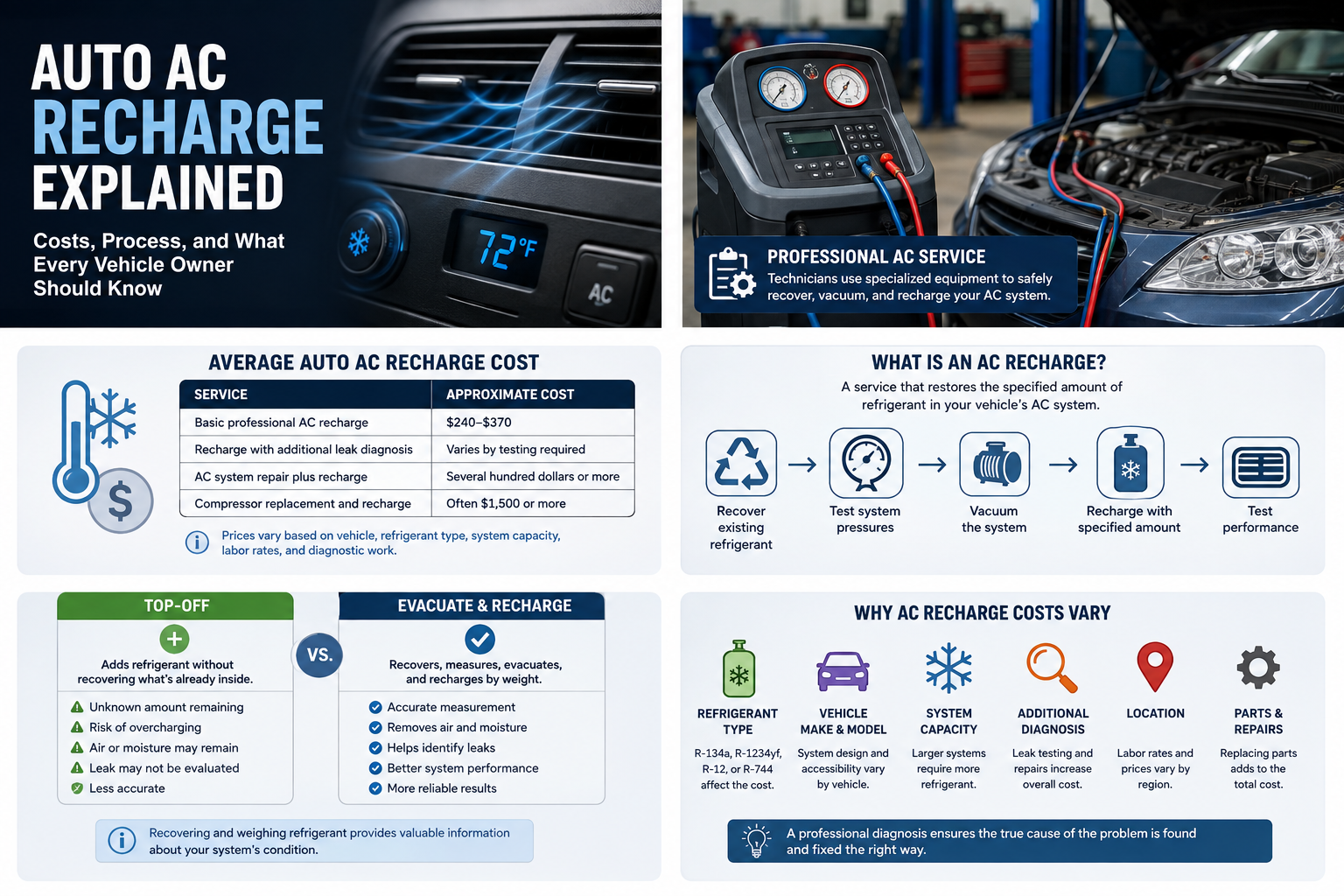
When a vehicle’s AC blows warm air, low refrigerant may be the cause, but a recharge is not always a complete repair. Refrigerant circulates through a closed system, so a low charge usually indicates a leak from a hose, seal, valve, condenser, evaporator, compressor, or another component.
Adding refrigerant may temporarily restore cooling, but the problem can return unless the leak is diagnosed and repaired.
A professional AC recharge typically costs about $240 to $370, depending on the vehicle, refrigerant type, system capacity, labor rates, and diagnostic work. Kelley Blue Book estimates roughly the cost as being between $239 to $310, while RepairPal lists prices between $282 to $366.
Those figures cover the recharge itself. Costs increase if the system also needs a compressor, hose, condenser, sensor, expansion valve, evaporator, or electrical repair.
Blagg Tire & Auto Service provides AC repair in Grapevine and Keller, TX, including refrigerant service, leak diagnosis, compressor inspection, electrical testing, and climate-control repairs.
Average Auto AC Recharge Cost
A reasonable national estimate for a standard professional recharge is:
| Service | Approximate cost |
| Basic professional AC recharge | $240-$370 |
| Recharge with additional leak diagnosis | Varies by testing required |
| AC system repair plus recharge | Several hundred dollars or more |
| Compressor replacement and recharge | Often $1,500 or more |
These are broad estimates rather than guaranteed prices. Kelley Blue Book currently approximates the average cost of complete AC repair to be between $384 and $445 and an AC compressor replacement costing between $1,546 to $1,705. The price for a specific vehicle can fall outside those ranges because of differences in parts availability, refrigerant type, system design, and local labor rates.
What Is an Auto AC Recharge?
An auto AC recharge is a service that restores the specified amount of refrigerant in the vehicle’s air-conditioning system.
The word “recharge” can be misleading because the refrigerant is not an electrical charge and does not wear out through normal use. The service generally involves recovering the existing refrigerant, evaluating the system, and refilling it with the exact refrigerant amount specified by the vehicle manufacturer.
A proper recharge may include:
- Identifying the correct refrigerant
- Inspecting accessible AC components
- Measuring system pressures and vent temperature
- Recovering the refrigerant already in the system
- Measuring how much refrigerant was recovered
- Pulling the system into a vacuum
- Checking whether the system maintains the vacuum
- Adding the manufacturer-specified refrigerant quantity by weight
- Adding the correct type and amount of compressor oil when required
- Operating the AC and confirming pressure and temperature performance
- Checking for evidence of leaks
Professional shops must use approved refrigerant-handling equipment, and technicians servicing motor-vehicle AC systems for compensation must hold EPA Section 609 certification. EPA rules also prohibit venting most automotive refrigerants into the atmosphere.
What Is the Difference Between Recharging and Topping Off the AC?
A top-off adds refrigerant to an existing system without first recovering and weighing what is already inside.
An evacuate-and-recharge service removes the refrigerant, measures the recovered amount, evacuates the system, and installs the specified charge by weight.
The U.S. Environmental Protection Agency’s (EPA) regulations do not require every low system to be completely evacuated; rather, it may be topped off. However, state or local rules may differ.
A shop may still prefer recovery and recharge because automotive AC systems are sensitive to charge quantity, and pressure readings alone do not always reveal exactly how much refrigerant is present.
Topping off can create several uncertainties:
- The technician may not know how much refrigerant remains.
- The system may become overcharged.
- Air or moisture may remain inside.
- The refrigerant may be contaminated.
- The underlying leak may not be evaluated.
- A previously added stop-leak product may affect service equipment.
Recovering and weighing the refrigerant provides more useful information. If a vehicle requiring 20 ounces contains only eight ounces, the technician knows that a substantial loss has occurred. If nearly the full amount is recovered, low refrigerant may not be the reason the vents are warm.
Why Does the Cost of an AC Recharge Vary?
There is no universal recharge price because vehicle air-conditioning systems differ substantially.
Refrigerant Type
The refrigerant is one of the largest variables.
Most modern vehicles use one of two common refrigerants:
- R-134a
- R-1234yf
Older vehicles may use R-12, while a limited number of newer applications may use carbon dioxide refrigerant identified as R-744.
The refrigerants are not interchangeable. A system designed for R-134a cannot simply be filled with R-1234yf without approved system modifications, and R-12 cannot be mixed with either one.
R-1234yf service usually costs more because the refrigerant itself is more expensive and requires dedicated recovery, identification, charging, and safety equipment. EPA classifies R-1234yf as mildly flammable and requires systems using it to meet applicable safety and fitting standards.
Refrigerant Capacity
A compact car may hold considerably less refrigerant than a large SUV, passenger van, or truck equipped with front and rear air conditioning.
More refrigerant generally means a higher material cost.
The correct capacity is usually printed on a label under the hood and listed in the manufacturer’s service information. Even a difference of a few ounces can affect performance on systems with small total capacities.
The Amount of Refrigerant Remaining
A system that is slightly low requires less replacement refrigerant than one that is nearly empty.
However, a nearly empty system also raises a more serious question: Where did the refrigerant go?
A significant loss may require a longer leak inspection, dye testing, nitrogen pressure testing, electronic leak detection, or component disassembly.
Diagnostic Labor
Warm vent air does not automatically prove the refrigerant is low.
A professional may need to inspect:
- Compressor command and operation
- High- and low-side pressures
- Condenser fan operation
- Refrigerant temperature
- Ambient temperature
- Vent temperature
- Electrical circuits
- Pressure sensors
- Blend-door operation
- Climate-control module data
- Cabin airflow
- Cooling-system condition
- Stored diagnostic trouble codes
Blagg Tire provides vehicle diagnostic testing in Grapevine and Keller for complaints that require more than a basic visual inspection.
Leak Location
Some leaks are relatively accessible. A damaged service-port valve core, external O-ring, or visible hose connection may be straightforward to repair.
Others are much more labor-intensive.
An evaporator is commonly buried inside the dashboard. Replacing it may require removing much of the instrument panel. A compressor failure may contaminate the system with metal debris, requiring the replacement of additional parts and extensive flushing.
The recharge may represent only a small portion of the total invoice once the leak is located.
R-134a vs. R-1234yf Recharge Cost
R-134a was the dominant automotive refrigerant for many years after R-12 was phased out in new vehicles. R-1234yf became increasingly common as manufacturers transitioned to a refrigerant with a much lower Global Warming Potential (GWP).
EPA currently lists a GWP value of approximately 1,430 for R-134a and approximately 4 for R-1234yf. Neither refrigerant depletes stratospheric ozone, but R-1234yf has a much lower climate impact when released.
From a customer’s perspective, the important differences are practical:
- The systems use different service fittings.
- They require different service machines.
- Refrigerants must not be mixed.
- R-1234yf is generally more expensive.
- A refrigerant identifier may be used before recovery.
- R-1234yf equipment incorporates additional safety procedures.
The vehicle’s underhood label should identify the correct refrigerant and charge quantity.
Do not choose a refrigerant based on price. Using the wrong product can contaminate the system, damage components, pose safety risks, and make subsequent professional service more difficult.
Common Signs Your Car May Need an AC Recharge
The Vents Blow Cool but Not Cold
A partially charged system may still cool the air but may not reach the expected vent temperature, especially in hot weather or at low speeds.
However, reduced cooling can also be caused by restricted airflow, a dirty condenser, compressor wear, or a blend-door problem.
The AC Becomes Warmer Over Time
Gradual deterioration over several weeks or months is consistent with a slow refrigerant leak.
A system that suddenly stops cooling may have experienced a larger leak, electrical failure, broken belt, compressor problem, or control-system fault.
The Compressor Cycles Frequently
Some clutch-operated compressors cycle normally. Excessively rapid cycling may indicate low refrigerant, but it can also result from a pressure sensor fault, airflow problem, temperature input issue, or control strategy.
Cycling behavior cannot diagnose the charge level on its own.
Cooling Improves While Driving
When the air becomes cold on the highway, but warm at idle, possible causes include:
- Weak condenser airflow
- Failed electric cooling fan
- Fan-control problem
- Dirty or damaged condenser
- Incorrect refrigerant charge
- Compressor performance problem
- Excessively high system pressure
The vehicle’s movement forces more air through the condenser, temporarily masking the problem.
Blagg Tire’s electrical-system diagnostic and repair service can help when fan motors, relays, wiring, modules, or electrical controls are involved.
One Side of the Vehicle Is Warmer Than the Other
Low refrigerant can sometimes create uneven evaporator cooling, causing one set of vents to feel warmer.
However, dual-zone vehicles also use separate temperature doors and actuators. A failed blend-door actuator may affect only the driver or passenger side.
A recharge should not be performed solely because one vent is warmer.
The AC Stops Cooling During the Hottest Part of the Day
A marginally low system may appear acceptable in mild weather but struggle when the outside temperature, sun load, and cabin heat increase.
The compressor, condenser airflow, and refrigerant charge must all perform correctly under higher demand.
There Is Visible Refrigerant Dye or Oily Residue
The refrigerant itself evaporates, but compressor oil travels with it. A leak may leave oily residue around a hose connection, condenser, compressor seal, or fitting.
Some systems also contain ultraviolet dye from the factory or a previous service. Under the correct light, the dye may help identify the leak.
Oily residue is evidence worth inspecting, but not every dirty or damp component is leaking.
Signs the Problem Is Not Simply Low Refrigerant
The Blower Does Not Work
If no air comes from the vents, the problem may involve:
- Blower motor
- Blower resistor or control module
- Fuse
- Relay
- Wiring
- Climate-control panel
- Electrical ground
- Blocked or severely restricted filter
Adding refrigerant will not restore airflow.
Airflow Is Weak, but the Air Is Cold
Weak airflow often points to the blower, cabin air filter, evaporator icing, damaged air duct, or door-position problem.
A clogged cabin air filter can reduce airflow while the refrigerant system continues to produce cold evaporator air.
Blagg’s factory-scheduled maintenance services include filter inspections and replacement, along with other routine vehicle maintenance.
The Air Smells Musty
A musty odor is commonly associated with moisture, microbial growth on the evaporator, a dirty cabin filter, or a blocked evaporator drain.
Refrigerant does not typically cause damp-sock smell coming through the vents.
The Compressor Is Noisy
Grinding, rattling, knocking, or squealing may indicate compressor, bearing, clutch, belt, tensioner, or internal system damage.
Adding refrigerant to a failing compressor may not solve the problem and could allow additional debris to circulate.
The Temperature Changes When the Controls Are Adjusted
If the system can produce cold air but cannot maintain the selected temperature, the issue may be inside the HVAC housing or control electronics rather than the refrigerant circuit.
The Engine Is Overheating
A vehicle with cooling-system problems may shut down or limit AC operation to reduce engine load and heat.
A failed radiator fan may affect both engine temperature and AC condenser performance. An AC recharge does not repair an overheating engine.
What Is Freon, and Is It the Same as Refrigerant?
Freon is a trademark historically associated with several refrigerants. Drivers often use the term generically to describe any automotive AC refrigerant.
Technically, the vehicle may use:
- R-12
- R-134a
- R-1234yf
- R-744
- Another approved refrigerant
Using the exact refrigerant designation is more accurate and helps prevent mixing incompatible products.
When requesting service, it is fine to say the AC may need Freon, but the technician should confirm which refrigerant the vehicle actually requires.
Can You Recharge a Car AC Yourself?
DIY recharge products are widely available, and a basic kit may cost less than professional service. Kelley Blue Book currently estimates a DIY recharge setup costing roughly $80 to $130.
The apparent savings should be weighed against several risks.
You May Misdiagnose the Problem
Warm air can be caused by an electrical failure, broken compressor, bad fan, blend-door issue, restricted expansion valve, or another fault.
Adding refrigerant will not correct those problems.
You Cannot Easily Know the Existing Charge
A single low-side gauge does not indicate the exact refrigerant weight inside the system.
Automotive systems are charged by weight, not merely by matching a pressure reading to a color range.
You Can Overcharge the System
Many DIY users assume that more refrigerant means colder air.
An overcharged system may cool poorly and operate at excessive pressure.
You May Use the Wrong Refrigerant
R-134a and R-1234yf are not interchangeable.
Some aftermarket products also contain hydrocarbons or alternative blends that are not approved for the vehicle. The EPA lists most hydrocarbon refrigerants as unacceptable for use in new or retrofitted motor-vehicle AC systems because of safety concerns.
Stop-Leak Products Can Create Problems
Some recharge cans contain sealant marketed as “stop leak.”
Sealants may react with moisture, clog small passages, contaminate service equipment, or complicate future repair. Shops may test for sealant or decline to connect contaminated systems to standard recovery machines.
Refrigerant Can Cause Injury
Liquid refrigerant can cause severe frostbite if it contacts skin or eyes.
R-1234yf is also mildly flammable, and all refrigerants should be handled with proper equipment and ventilation.
Venting Refrigerant Is Prohibited
EPA regulations generally prohibit intentional release of automotive refrigerants into the atmosphere.
A professional service can cost more upfront but provides recovery, accurate charging, system measurement, and a better chance of identifying the actual failure.
Auto AC Recharge and Repair in Grapevine and Keller, TX
An AC recharge may cost approximately $240 to $370 as a broad national estimate, but the price should not be viewed in isolation.
The more important questions are:
- Why is the refrigerant low?
- How quickly did it escape?
- Which refrigerant does the vehicle require?
- Is the compressor operating correctly?
- Are the condenser fans working?
- Is the airflow restricted?
- Does the system have an electrical or control problem?
- Will a recharge provide a lasting repair?
Blagg Tire & Auto Service provides auto AC recharge and air-conditioning repair for drivers in Grapevine and Keller. The team services refrigerant systems, compressors, condensers, evaporators, hoses, cabin filters, and related electrical components.
For intermittent or difficult-to-identify problems, Blagg also provides vehicle diagnostics, electrical-system repair, digital vehicle inspections, and factory-scheduled maintenance.
You can find a Blagg Tire location at:
- Blagg Tire & Auto Service Grapevine: 604 S. Main Street, Grapevine, TX 76051
- Blagg Tire & Auto Service Keller: 248 Keller Parkway, Keller, TX 76248
Blagg’s location information confirms that both shops serve local drivers with AC repair, diagnostics, routine maintenance, tires, and other automotive services.
Schedule service through the Blagg Tire appointment page when the air is no longer cold, the compressor is noisy, the cooling changes with vehicle speed, or the system has required more than one recharge.