Brake Pads vs. Rotors: What’s the Difference, and Do You Really Need Both?
When you bring your vehicle in for a brake inspection, it’s common to hear that you need new brake pads, rotors, or both. Most drivers understand that brake pads wear out over time. Rotors, however, are often less familiar, which can make it difficult to know whether a recommended brake repair is truly necessary or simply an added expense.
The truth is that brake pads and rotors work together every time you press the brake pedal. They serve different purposes, wear at different rates, and create different symptoms when something goes wrong. However, the condition of one directly affects the performance of the other.
Understanding the difference between brake pads and rotors can help you make better decisions about your vehicle, avoid unnecessary repairs, and recognize brake problems before they become more expensive.
Quick Answer: What Is the Difference Between Brake Pads and Rotors?
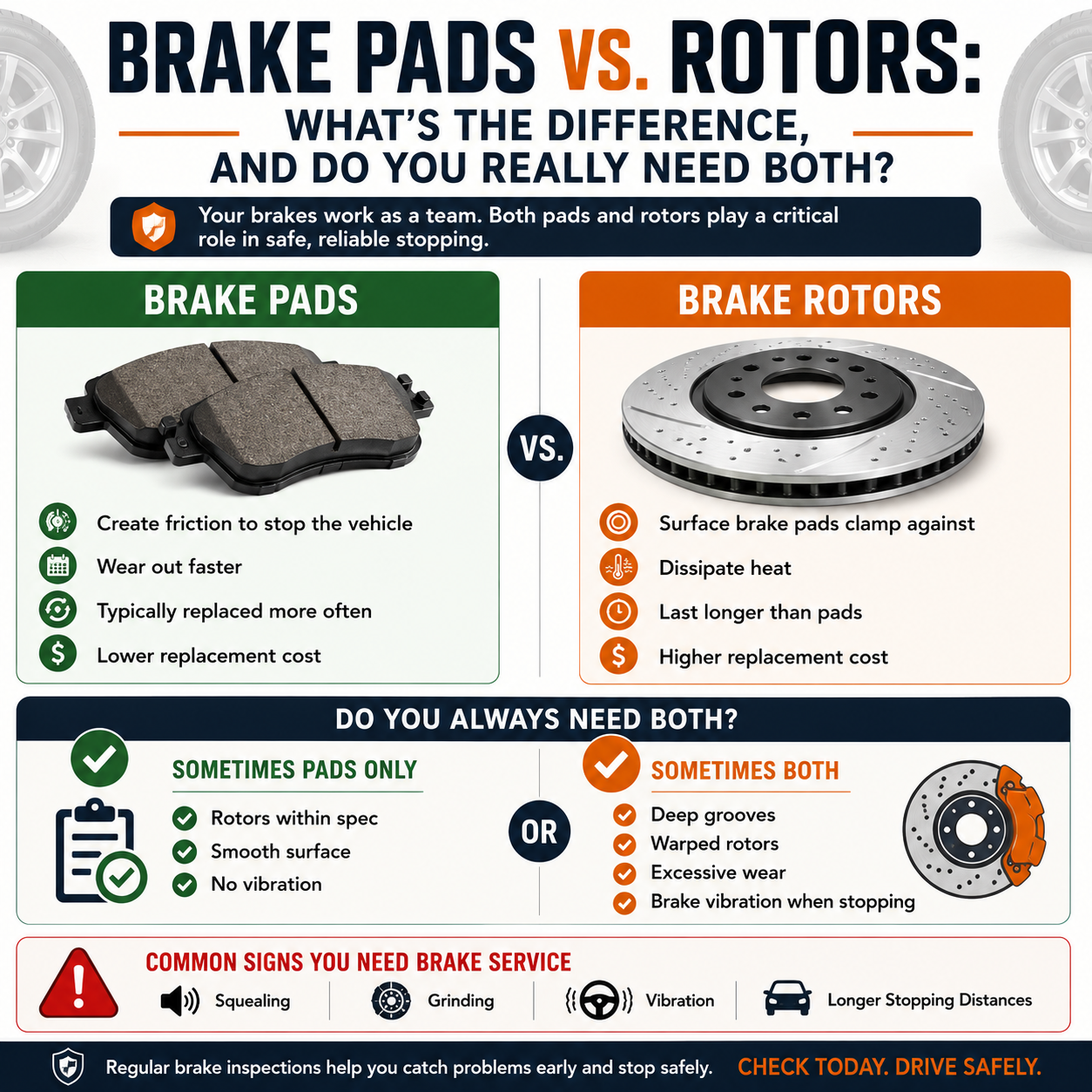
Brake pads are the friction material that press against the rotor to slow your vehicle. Rotors are the metal discs attached to the wheels that the pads clamp down on. Brake pads usually wear faster and are replaced more often, while rotors may last through multiple sets of pads depending on their condition, thickness, heat exposure, and driving habits.
If your brakes are squealing, grinding, vibrating, or taking longer to stop, schedule a professional inspection with Blagg Tire’s brake service team.
Brake Pads vs. Rotors: Understanding the Basics
Think of brake pads and rotors as a matched pair.
Brake pads are made from friction material. When you press the brake pedal, the brake caliper pushes the pads against the rotor. The pads create the friction needed to slow the vehicle.
Rotors are the large metal discs mounted behind the wheels. As the pads squeeze the rotor, friction converts the vehicle’s motion into heat. That heat must be absorbed and released safely for the braking system to work properly.
Every stop creates heat. Every stop creates wear. Over time, both parts change, but brake pads are designed to wear faster because they are the sacrificial component of the braking system.
What Most Drivers Don’t Know About Brake Wear
Many drivers assume brake wear is mostly about mileage.
In reality, driving conditions often matter more than the odometer.
A vehicle driven mostly on highways may go much longer between brake services than the same vehicle used in daily stop-and-go traffic. Two cars with 50,000 miles can have completely different brake conditions depending on how they are driven.
Brake wear is affected by:
- Stop-and-go traffic
- Vehicle weight
- Driving habits
- Towing or hauling
- Tire condition
- Brake fluid condition
- Caliper operation
- Road conditions
- Driving in hills or heavy traffic
A driver who brakes early and smoothly may get far more life from brake pads and rotors than someone who frequently brakes hard at the last second.
How Do Brake Pads Wear Out?
Brake pads naturally become thinner over time. Each time you press the brake pedal, a small amount of friction material wears away.
As brake pads approach the end of their lifespan, you may notice:
- Squealing or squeaking noises
- Grinding sounds
- Longer stopping distances
- Reduced braking responsiveness
- Brake warning lights
- Vibration or pulsing while braking
What Most Drivers Don’t Know About Brake Squealing
That high-pitched squeal is not always random brake noise.
Many brake pads include a built-in wear indicator. This small metal tab is designed to make noise when the pads are getting low. It is essentially an early warning system.
If you hear consistent squealing, it does not always mean the brakes have failed. It often means you still have time to schedule service before the pads wear down completely and damage the rotors.
Actionable Tip: Don’t Wait for Grinding
Squealing is usually a warning. Grinding is often a sign that the friction material is gone or nearly gone.
Once grinding begins, metal components may be contacting the rotor directly. That can turn a simple brake pad replacement into a more expensive brake repair involving rotors, calipers, or hardware.
If your brakes are making noise, schedule brake service at Blagg Tire & Auto Service before the damage spreads.
What Causes Rotors to Wear?
Rotors are built to last longer than brake pads, but they do not last forever.
Every braking event generates heat. Over thousands of heat cycles, rotors can lose material, develop surface irregularities, or become too thin to safely reuse.
Common rotor problems include:
- Surface grooves
- Heat spots
- Rust and corrosion
- Excessive thinning
- Cracking
- Rotor thickness variation
- Brake pulsation
- Uneven pad contact
Rotors are measured during a brake inspection to determine whether they are still within manufacturer specifications. If they are too thin, heavily grooved, cracked, or heat damaged, replacement is usually the safest option.
What Most Drivers Don’t Know About “Warped Rotors”
Many drivers describe brake vibration as “warped rotors.”
True rotor warping is less common than most people think. In many cases, the vibration comes from uneven brake pad deposits on the rotor surface or variations in rotor thickness.
To the driver, the symptoms feel almost identical:
- Steering wheel shake while braking
- Brake pedal pulsation
- Vibration at higher speeds
- Uneven braking feel
That is why inspection matters. A technician needs to determine whether the issue is rotor thickness variation, pad deposits, worn suspension parts, tire balance, or another problem.
Signs Your Rotors May Need Attention
Rotor problems often create symptoms that drivers mistake for tire or suspension issues.
Common warning signs include:
- Steering wheel vibration while braking
- Brake pedal pulsation
- Grinding or scraping noises
- Longer stopping distances
- Uneven brake pad wear
- Burning smell after braking
- Vehicle shaking when slowing down
Real-World Technician Insight: “My Steering Wheel Shakes When I Brake”
One of the most common brake complaints is steering wheel vibration during braking.
Many drivers assume this means they need tire balancing or a wheel alignment. Sometimes they do. However, brake pulsation is frequently caused by rotor wear, uneven rotor surfaces, or brake component problems.
Because braking, steering, tires, and suspension all affect how the vehicle feels, a complete inspection is usually more helpful than guessing.
A full-service shop like Blagg Tire & Auto Service can evaluate brake condition along with tire services and related vehicle systems when vibration, pulling, or uneven wear appears.
Do You Always Need Both Brake Pads and Rotors?
No. Brake pads and rotors do not always need to be replaced together.
This is one of the biggest misconceptions about brake repair.
Whether you need pads only, rotors only, resurfacing, or a complete brake service depends on the condition of the parts.
Rotors may be reusable if they are:
- Still above minimum thickness
- Smooth enough for proper pad contact
- Free from major heat damage
- Not cracked or heavily grooved
- Not causing brake pulsation
Rotors usually need replacement if they are:
- Below minimum thickness
- Heavily grooved
- Cracked
- Heat damaged
- Severely rusted
- Causing vibration
- Unable to be resurfaced safely
Quick Answer: Can You Replace Brake Pads Without Replacing Rotors?
Yes, sometimes. If the rotors are still within manufacturer specifications and the surface condition is good, new brake pads may be installed without replacing the rotors. However, installing new pads on damaged rotors can cause noise, vibration, uneven pad wear, and reduced braking performance.
Why New Pads on Bad Rotors Can Cost More Later
Installing new brake pads on damaged rotors may seem like a way to save money, but it can create more problems.
New pads need a clean, even rotor surface to make proper contact. If the rotor is grooved, uneven, heat damaged, or too thin, the new pads may wear incorrectly from the start.
That can lead to:
- Faster brake pad wear
- Continued vibration
- Increased noise
- Poor braking performance
- Uneven pad contact
- Another repair sooner than expected
Brake pads and rotors wear into one another. When one surface is badly worn, it can affect the other.
This is why reputable shops inspect both components before recommending repairs.
Why Brake Problems Can Affect More Than Stopping Power
Many drivers think of brakes as a separate system. In reality, brake issues can affect other parts of the vehicle.
For example:
- Uneven braking can contribute to irregular tire wear.
- Rotor vibration can place stress on suspension components.
- Sticking calipers can reduce fuel economy.
- Brake drag can generate excessive heat.
- Pulling while braking can affect steering control.
- Worn tires can reduce braking performance.
A vehicle that pulls during braking may eventually develop uneven tire wear. A vibration that feels like a brake issue may also involve suspension or tire concerns.
This is why brake inspections often overlap with steering, suspension, and tire inspections.
If your vehicle has brake noise, vibration, uneven tire wear, or pulling, Blagg Tire can help evaluate related systems through brake service and tire inspections.
What Most Drivers Don’t Know About Brake Fluid
Brake pads and rotors get most of the attention, but brake fluid is also critical.
Brake fluid transfers force from the brake pedal to the braking components. Over time, it can absorb moisture, which may reduce performance and contribute to internal corrosion.
Old or contaminated brake fluid can affect:
- Pedal feel
- Hydraulic pressure
- Caliper operation
- ABS performance
- Long-term brake system reliability
A complete brake inspection should include more than just looking at the pads. It should also consider fluid condition, hardware, calipers, hoses, and overall system performance.
How Technicians Determine What You Actually Need
A professional brake inspection goes beyond a quick visual check.
Technicians evaluate:
- Brake pad thickness
- Rotor thickness
- Rotor surface condition
- Heat damage
- Brake fluid condition
- Caliper operation
- Brake hose condition
- Brake hardware
- Uneven wear patterns
- Tire and suspension concerns
The goal is not simply to replace parts. The goal is to determine what is still serviceable, what is worn, and what should be addressed now to prevent larger repairs later.
Common Misconception: A Brake Inspection Is Not Just a Sales Pitch
Many drivers worry that a brake inspection automatically means an expensive repair recommendation.
A good inspection should give you information. Sometimes the result is that no immediate repair is needed. Other times, it helps you plan ahead before the brakes become unsafe or more expensive to fix.
At Blagg Tire & Auto Service, technicians focus on helping drivers understand what is actually happening with their vehicles rather than applying a one-size-fits-all recommendation.
Take Advantage of Free Vehicle Inspections
One of the easiest ways to stay ahead of expensive brake repairs is to take advantage of free vehicle inspections during routine service visits.
Many brake problems develop gradually. A technician may spot early warning signs before you feel anything unusual from the driver’s seat.
A free vehicle inspection may identify:
- Low brake pad thickness
- Rotor wear
- Brake fluid concerns
- Tire wear patterns
- Suspension wear
- Alignment concerns
- Steering component wear
- Fluid leaks
- Uneven braking symptoms
What Most Drivers Don’t Know About Tire Wear and Brake Problems
Tires often show early signs of brake, suspension, or alignment issues.
Uneven tire wear may point to:
- Alignment problems
- Suspension wear
- Steering issues
- Improper inflation
- Brake-related concerns
Brake problems do not always stay limited to the braking system. If a caliper sticks, a rotor vibrates, or the vehicle pulls while braking, the effects can show up elsewhere.
That is why technicians may recommend checking tires, suspension, and alignment along with the brakes.
Learn more about Blagg Tire’s tire services if your vehicle has uneven wear, vibration, pulling, or ride-quality concerns.
Preventative Maintenance Saves Money
Brakes are usually less expensive to maintain than to repair after failure.
Consider the difference:
- Replacing worn brake pads is usually less expensive than replacing pads and damaged rotors.
- Addressing rotor wear early is usually less expensive than waiting until calipers, hardware, or hydraulic parts are affected.
- Correcting a brake-related pull early may help prevent uneven tire wear.
- Inspecting brake fluid may help prevent longer-term hydraulic issues.
The earlier a problem is identified, the more options drivers usually have.
Real-World Technician Insight: Waiting Often Costs More
One of the most common situations shops see is a driver hearing brake noise for weeks or months before scheduling service.
By the time the vehicle arrives, the repair may no longer be just pads. The rotors may be damaged, the calipers may be stressed, or the brake hardware may need attention.
The sooner brakes are inspected, the better the chance of keeping the repair simpler.
A Trusted Dealership Alternative for Brake Service
Many drivers assume they need to visit the dealership for brake repairs, diagnostics, maintenance, warning lights, or major service recommendations.
In reality, an experienced independent shop can often provide the same practical brake inspections and repairs with more personal communication and transparent recommendations.
At Blagg Tire & Auto Service, drivers can get help with brake pad replacement, rotor resurfacing, rotor replacement, diagnostics, inspections, tires, and general auto repair services.
The goal is simple: explain what your vehicle needs, why it matters, and which repairs should be prioritized.
Financing Options for Brake Repairs
Unexpected brake repairs can strain your budget, but safe brakes should not have to wait.
If your vehicle needs brake pads, rotors, calipers, or related repairs, auto repair financing options may help you address important safety concerns while spreading payments over time.
That can make it easier to handle needed repairs before a minor brake issue becomes a more expensive problem.
Don’t Wait Until Your Brakes Become a Bigger Problem
Brake pads and rotors are designed to wear, but waiting too long can turn routine maintenance into a larger repair.
If you have noticed squealing brakes, grinding noises, vibration while stopping, longer stopping distances, or changes in braking performance, schedule a brake inspection before the problem worsens.
The team at Blagg Tire & Auto Service can help you understand what is happening, explain your options, and recommend the most practical solution for your vehicle and budget.
Safe, reliable brakes are not just about stopping power. They are one of the most important safety systems on your vehicle.